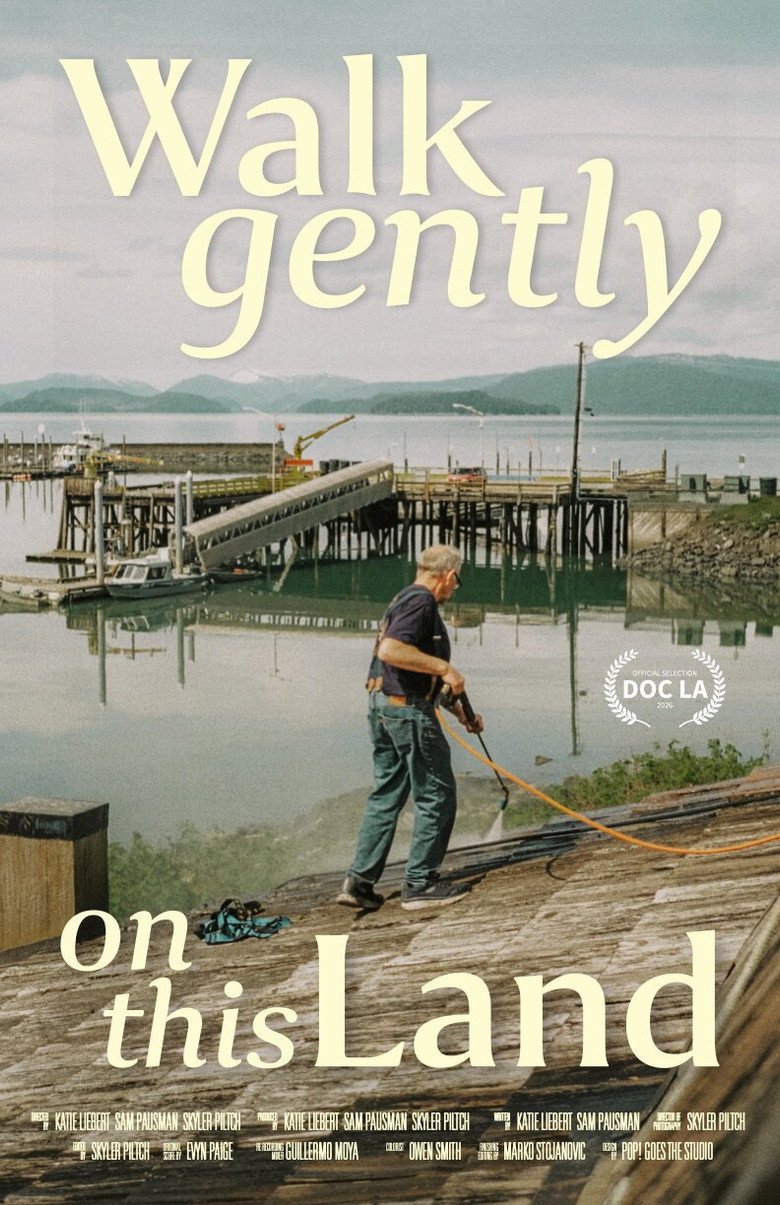
Walk Gently on This Land is a 17-minute documentary about life in a remote Alaskan island town facing a shrinking population. Through the experiences of tribal leaders, a logger, a teacher, and an oyster farmer, the film considers cultural continuity, community ties, and the challenges of living from the land.
Walk Gently on This Land is a 2026 documentary set in a remote Alaskan island community adapting to population decline. Its short running time brings together several personal perspectives on work, education, family, and cultural renewal.
The film focuses on people whose lives are closely connected to the town and its surroundings, including Tlingit leaders, the island’s last logger, a longtime teacher, and a newly arrived oyster farmer. Their stories provide a grounded view of a community negotiating change while maintaining its connection to the land.
Walk Gently on This Land movie details
| Title | Walk Gently on This Land |
|---|---|
| Release date | |
| Runtime | 17m |
| Genres | Documentary |
| Directors | Sam Pausman, Katie Liebert, Skyler Piltch |
| Writers | Sam Pausman, Katie Liebert |
| Status | Released |
Story without spoilers
The documentary follows two tribal leaders working toward a long-fought renaissance of Tlingit culture. Alongside their efforts, the film introduces the island’s last logger, who continues a family business, and a longtime teacher observing the paths taken by graduating students as they leave and later return home.
A further perspective comes from an oyster farmer who has recently arrived with a young family. He faces the uncertainty of making a living from the land, adding another dimension to the film’s portrait of an isolated town and its changing population.
What to expect
Viewers can expect a concise documentary built around several real people and their connections to the Alaskan island community. The subject matter includes Tlingit cultural renewal, family trades, education, migration away from home, return, and the practical uncertainty of land-based work.
At 17 minutes, the film presents a focused snapshot rather than an extended account of the town. Its structure is centered on the experiences of the people featured, with the community’s dwindling population providing the broader context.
Cast and creative team
The documentary features Mike Aak’wtaatseen Hoyt, Esther Aaltséen Reese, Brian Herman, Barbara Neyman, Mike Allen Jr., and Lee “Bones” Romane, all appearing as themselves. It is directed by Sam Pausman, Katie Liebert, and Skyler Piltch. Pausman and Liebert are also credited as writers.
- Mike Aak’wtaatseen Hoyt as Self
- Esther Aaltséen Reese as Self
- Brian Herman as Self
- Barbara Neyman as Self
- Mike Allen Jr. as Self
- Lee “Bones” Romane as Self
Release and production context
Walk Gently on This Land is a documentary released in 2026. It has a runtime of 17 minutes and is listed with a release date of October 15, 2026. The supplied production information does not specify a country, spoken language, or production company.
Movies Dock view
With its compact format and community-based subject matter, Walk Gently on This Land offers a focused portrait of an Alaskan island town at a moment of demographic and cultural change. Its range of viewpoints connects personal livelihoods with the wider question of how a small community sustains its identity and future.
Frequently asked questions
What is Walk Gently on This Land about?
It is a documentary about a remote Alaskan island town adapting as its population declines, including stories of Tlingit cultural renewal, family work, education, and living from the land.
How long is Walk Gently on This Land?
The documentary has a runtime of 17 minutes.
When was Walk Gently on This Land released?
It was released in 2026, with a listed release date of October 15, 2026.
Who directed Walk Gently on This Land?
The film was directed by Sam Pausman, Katie Liebert, and Skyler Piltch.
Who appears in the documentary?
Mike Aak’wtaatseen Hoyt, Esther Aaltséen Reese, Brian Herman, Barbara Neyman, Mike Allen Jr., and Lee “Bones” Romane appear as themselves.
Related posts:
 Champagne ! (2022) | Movie | Movies Dock
 All I Want is You 2 (2023) | Movie | Movies Dock
 Antar Nada (2026): Cast, Story and Release Details
 Ultimo – Tutto. Live a Tor Vergata (2026): Cast, Story and
 The Neighbor in the Window (2020) | Movie | Movies Dock
 DAKAICHI – I'm being harassed by the sexiest man of the year – the Movie: Spain Arc (2021) | Movies Dock
 Night Swim (2024) | Movie | Movies Dock
 Sound of Hope: The Story of Possum Trot (2024) | Movie | Movies Dock
 Jack Wrather: A Legacy of Film and Friendship (2022) | Movie | Movies Dock
 Misfit Mentor (2026): Cast, Story and Release Details
 Tiger Stripes (2023) | Movie | Movies Dock
 A Mother's Secret (2026): Cast, Story and Release Details


