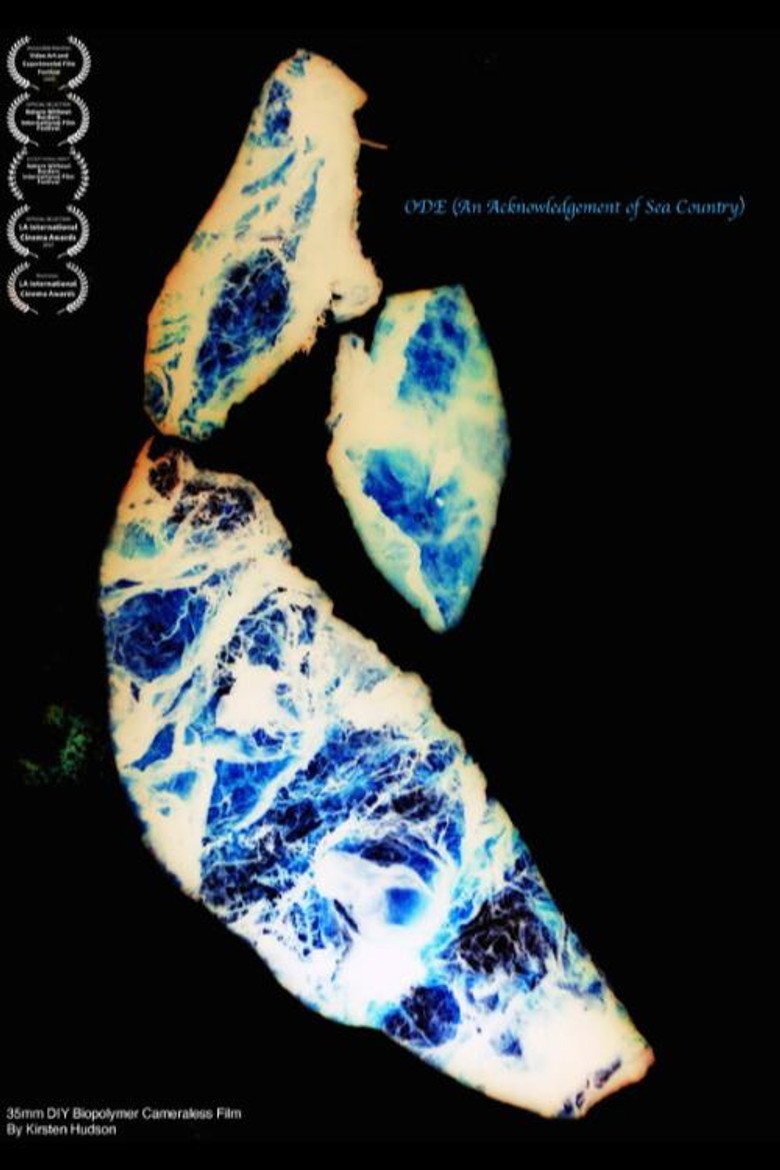
Ode (An Acknowledgement of Sea Country) is a six-minute Australian experimental animation created without a camera. Made from handmade macroalgae celluloid and developed with CSIRO and marine scientists, it considers ocean responsiveness, deep time and collaboration beyond the human perspective.
Ode (An Acknowledgement of Sea Country) is a short Australian animation built through an unusual material process rather than conventional camera-based filmmaking. Kirsten Hudson directs the six-minute work, which uses handmade macroalgae celluloid as its foundation.
Developed with CSIRO and marine scientists, the film connects experimental moving-image practice with seaweed-based materials, contact printing, botanicollage and seaweed bio-sonification. Its compact 365-second duration frames it as a concentrated meditation on oceanic and material processes.
Ode (An Acknowledgement of Sea Country) movie details
| Title | Ode (An Acknowledgement of Sea Country) |
|---|---|
| Release date | |
| Runtime | 6m |
| Director | Kirsten Hudson |
| Country | Australia |
| Status | Released |
Story without spoilers
Rather than presenting a conventional narrative, Ode uses cameraless animation to investigate how cinema might be made beyond petrochemical materials. The film’s imagery and sound are shaped through macroalgae celluloid, contact printing, botanicollage and seaweed bio-sonification.
Its stated focus is the relationship between the ocean, deep time, material intelligence and more-than-human collaboration. The result is described as an ocean-responsive meditation, placing process and environmental materiality at the center of the experience.
What to expect
Viewers can expect an experimental, nontraditional short rather than a character-led story. The film’s six-minute length and cameraless construction suggest a tightly focused work organized around texture, process and sensory exploration.
Its use of handmade macroalgae celluloid gives the production a distinctly material basis, while contact printing and botanicollage point to an image-making method rooted in direct physical transformation. Seaweed bio-sonification adds a sound dimension connected to the same marine source. The supplied details position Ode as a work of experimental animation and post-petrochemical cinema.
Cast and creative team
Ode (An Acknowledgement of Sea Country) is directed by Kirsten Hudson. No cast or writers are listed in the supplied information. The project was developed with CSIRO and marine scientists, whose involvement is identified as part of the film’s development.
Release and production context
Ode (An Acknowledgement of Sea Country) is an Australian production with a listed release date of November 14, 2026. It is marked as released and has a runtime of six minutes, or 365 seconds. No spoken language, production company or genre classification is provided.
Movies Dock view
With its handmade macroalgae celluloid, cameraless animation and marine-science development, Ode (An Acknowledgement of Sea Country) is defined by its distinctive production method. It offers a brief, formally experimental examination of how ocean-derived materials and more-than-human collaboration can shape cinema.
Frequently asked questions
What is Ode (An Acknowledgement of Sea Country) about?
It is a cameraless animation exploring post-petrochemical cinema, deep time, material intelligence and more-than-human collaboration through ocean-responsive methods.
Who directed Ode (An Acknowledgement of Sea Country)?
Kirsten Hudson directed the film.
How long is Ode (An Acknowledgement of Sea Country)?
The film lasts six minutes, or 365 seconds.
What materials were used to make the film?
It was made from handmade macroalgae celluloid and uses contact printing, botanicollage and seaweed bio-sonification.
Was Ode developed with marine scientists?
Yes. The film was developed with CSIRO and marine scientists.
Film data:
TMDB
Related posts:
 Cheekatilo (2026) | Movie | Movies Dock
 Seized (2020) | Movie | Movies Dock
 Exposure (2026): Cast, Story and Release Details
 Infinitely Absent To Creation: Cast, Story and Release Details
 MEMORY STICK (HOW TO PREPARE NEW YEARS) (2026): Cast, Story and
 Bhediya (2022) | Movie | Movies Dock
 Romare Bearden: A Life in Collage (2026): Cast, Story and Release
 Wirbel (2026): Cast, Story and Release Details
 The Womb (2024) | Movie | Movies Dock
 Thunder Force (2021) | Movie | Movies Dock
 The Bad Guys (2022) | Movie | Movies Dock
 Idda (2026): Cast, Story and Release Details