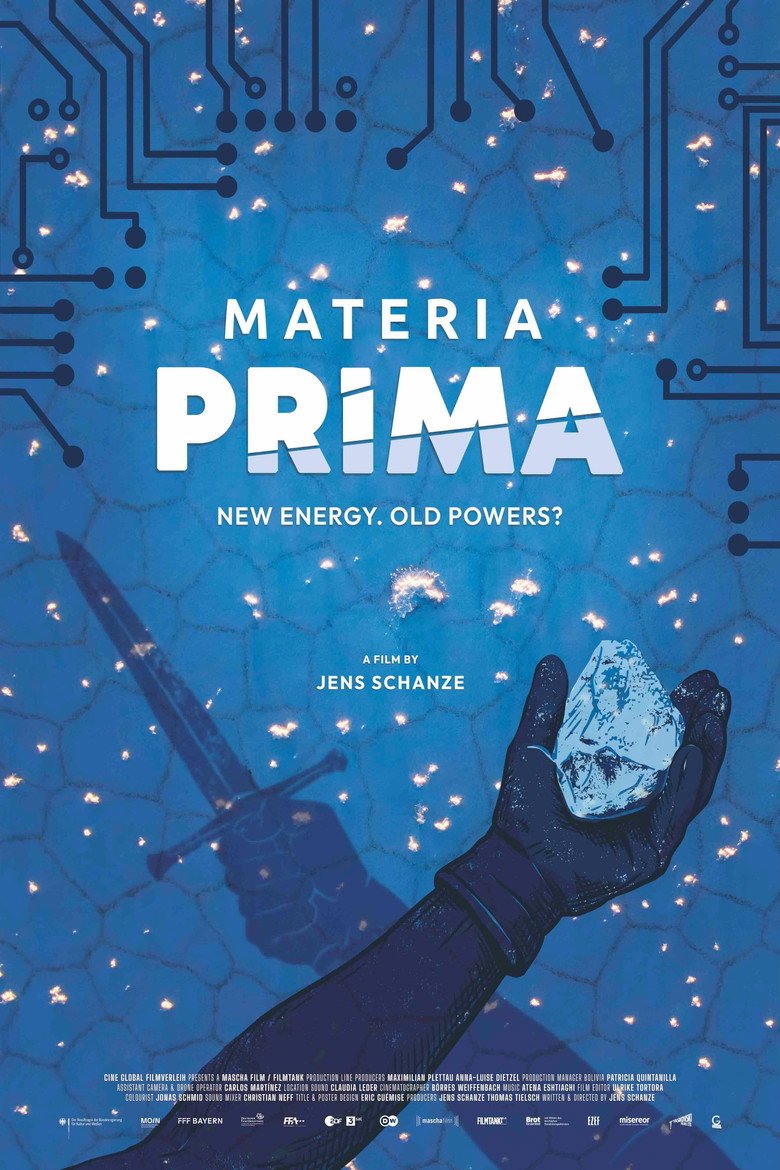
Materia Prima examines the struggle over Bolivia’s lithium resources as European companies seek supplies for the automotive industry and Bolivian communities debate development, poverty and extractivism. Directed by Jens Schanze, the documentary follows negotiations and rural mobilisation, particularly among women, within the broader energy transition.
Materia Prima looks at the political and social tensions surrounding Bolivia’s lithium reserves, placing the resource at the center of an international contest over the future of energy and transport.
Directed by Jens Schanze, the 2026 documentary connects European industrial ambitions with the concerns of Bolivian civil society groups, especially women organising in rural areas.
Materia Prima movie details
| Title | Materia Prima |
|---|---|
| Release date | |
| Runtime | 1h 29m |
| Genres | Documentary |
| Director | Jens Schanze |
| Country | Germany |
| Languages | Aymara, English, Quechua, Spanish |
| Status | Released |
Story without spoilers
Bolivia holds the world’s largest deposits of lithium, a material used in electricity storage systems, data centres, electric cars and smartphones. As European interests pursue access to the resource for the automotive industry, the Bolivian government negotiates with corporations from around the world.
At the same time, local groups mobilise outside the centers of political and commercial power. Their involvement reflects a different set of priorities, including the effort to reduce poverty and the concern that lithium extraction and industrialisation may carry serious social and environmental consequences. The documentary presents these competing positions without revealing an outcome.

What to expect
This is a documentary focused on resource politics, the energy transition and the competing interests surrounding extractivism in Bolivia. Its subject brings together international business negotiations, the future of electric transport and grassroots mobilisation in rural communities.
The film’s perspective is grounded in the contrast between European demand for lithium and Bolivian debates about development. The presence of Aymara, English, Quechua and Spanish suggests a multilingual account of the issue, while the reported focus on women-led civil society groups gives local organising a central place.
Cast and creative team
Materia Prima is directed by Jens Schanze. No cast or writers are listed in the supplied production information.
Release and production context
Materia Prima is a German documentary with a runtime of 1 hour and 29 minutes. It is scheduled for release on October 22, 2026, and is listed as released in the supplied metadata. The spoken languages are Aymara, English, Quechua and Spanish. Production companies are Mascha Film and Cine Global Filmverleih.
Production companies: Mascha Film, Cine Global Filmverleih
Movies Dock view
Materia Prima frames lithium not simply as a technological resource but as the point where industrial policy, poverty reduction, corporate negotiation and community resistance meet. Its subject makes the documentary relevant to anyone seeking a clearer understanding of the political choices behind the global shift toward new energy systems.
Frequently asked questions
What is Materia Prima about?
It is a documentary about the struggle over Bolivia’s lithium deposits, including European demand, government negotiations and mobilisation by rural civil society groups.
Who directed Materia Prima?
The documentary was directed by Jens Schanze.
When is Materia Prima scheduled for release?
The supplied metadata lists October 22, 2026, as its release date.
How long is Materia Prima?
The runtime is 1 hour and 29 minutes.
What languages are spoken in the film?
The listed spoken languages are Aymara, English, Quechua and Spanish.
Related posts:
 Engi – Sound Designer Ivo Špalj (2023) | Movie | Movies Dock
 Tom and Jerry: Forbidden Compass (2025) | Movie | Movies Dock
 We, Brothers (2026): Cast, Story and Release Details
 NOIRE (2026) | Short Film / Cortometraje | Unreal Engine 5 &
 Job Seeker (2026): Cast, Story and Release Details
 Carapace (2026): Cast, Story and Release Details
 ZOÉ: MEMOREX + REXSEXEX Y MÁS: Cast, Story and Release Details
 Pacific (2026): Cast, Story and Release Details
 The Peasants (2023) | Movie | Movies Dock
 Duchoň (2025) | Movie | Movies Dock
 I am 18 or older (2026): Cast, Story and Release Details
 Mathu Vadalara 2 (2024) | Movie | Movies Dock