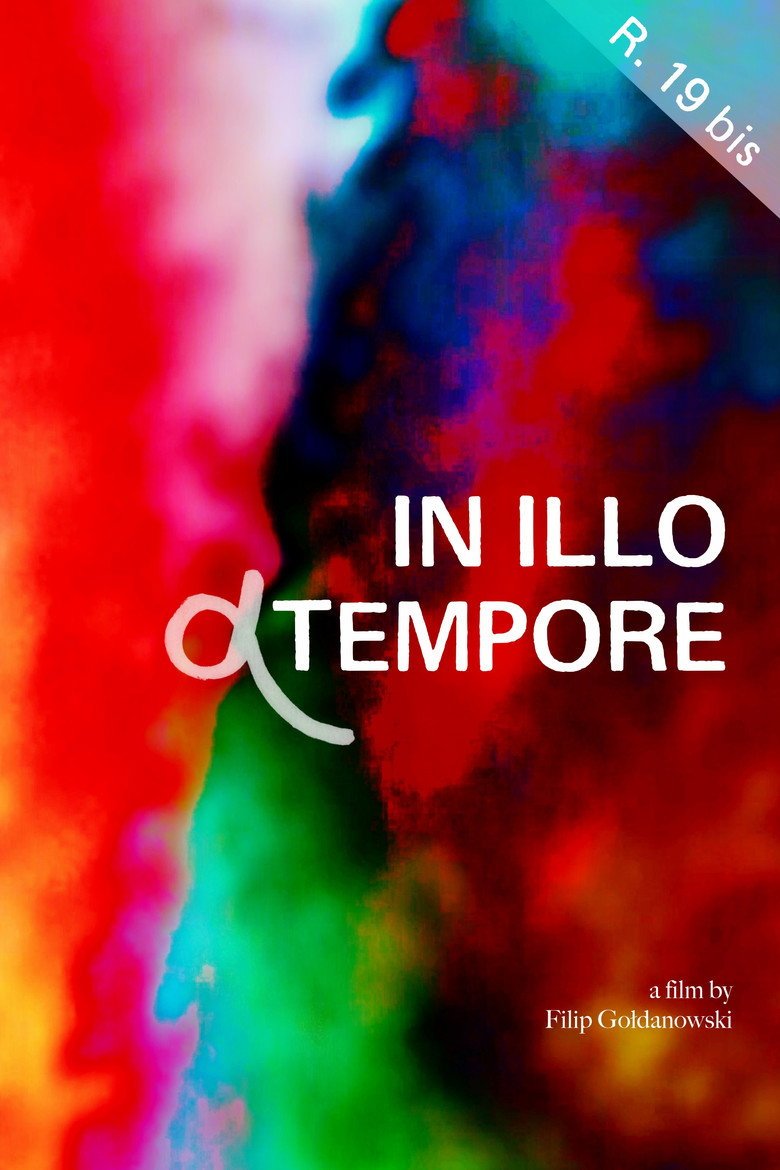
In illo αTempore is the seventh film in The Requiem Films cycle, an English-language experimental music documentary from Filip Gołdanowski. Its central idea grows from the phrase “in illo tempore” and the possibility of “aTempore”—a state understood as non-time, where temporal certainty gives way to abstract thought and sensation.
In illo αTempore is an experimental music documentary written and directed by Filip Gołdanowski. The 2026 film is the seventh installment in the cycle The Requiem Films and uses an introductory reflection on time, language and nothingness as its conceptual starting point.
Rather than presenting a conventional narrative in the supplied synopsis, the film is framed around the idea of “aTempore,” or “non-time.” Its listed keywords—nature, philosophical thought, abstraction, stream of consciousness and transcendentalism—point to a work shaped by ideas and impressions rather than a straightforward plot.
In illo αTempore movie details
| Title | In illo αTempore |
|---|---|
| Release date | |
| Runtime | 1h 13m |
| Genres | Music, Documentary |
| Director | Filip Gołdanowski |
| Writer | Filip Gołdanowski |
| Country | Poland, Austria |
| Languages | English |
| Status | Released |
Story without spoilers
The film begins from the familiar Latin phrase “in illo tempore,” commonly understood as “in that time.” Its introductory note focuses on the word “tempore” and then imagines the addition of an extra “a,” producing “aTempore.” This altered term becomes a way of considering “That Non-Time”: a condition in which time may have stopped, or in which different spaces and sensations become possible.
The supplied material does not describe a conventional storyline or identify specific events. Instead, In illo αTempore appears to organize its subject around philosophical questioning, musical and documentary elements, nature, and an abstract stream-of-consciousness approach. The tagline, “BUT NOTHINGNESS, DUE TO ITS LACK OF CONSEQUENCES, IS PURE …,” reinforces the film’s interest in absence, consequence and nonexistence without resolving those ideas in advance.

What to expect
Viewers can expect a 73-minute work situated between music and documentary, with an experimental and philosophical focus. The premise suggests that the film is less concerned with explaining “non-time” than with opening a space for reflection on time, stillness, sensation and nothingness.
Its listed keywords indicate an abstract, potentially meditative mode rather than a plot-led documentary structure. The film’s English-language presentation includes multiple voice roles, while the supplied information does not specify a traditional narrator, interview format or defined sequence of events.
Cast and creative team
Filip Gołdanowski writes and directs In illo αTempore and also appears as voice 1. Gerard Pape, Moritz Eggert, Aryan Omid, Ryszard Kryska and Jackson Laird are credited as voices 2 through 6, respectively. Iwona Gołdanowska appears as herself in an uncredited role.
- Filip Gołdanowski as voice 1
- Gerard Pape as voice 2
- Moritz Eggert as voice 3
- Aryan Omid as voice 4
- Ryszard Kryska as voice 5
- Jackson Laird as voice 6
- Iwona Gołdanowska as self (uncredited)
Release and production context
In illo αTempore is a 2026 production from Poland and Austria, spoken in English. It has a runtime of 1 hour and 13 minutes and is classified as both Music and Documentary. The film is listed as released on October 18, 2026, and its status is recorded as Released. No production companies are supplied.
In illo αTempore official trailer
Watch the official trailer on YouTube
Movies Dock view
With its focus on “aTempore,” In illo αTempore presents a deliberately open-ended meditation on the relationship between language, time and nothingness. Its place within The Requiem Films cycle, combined with its music-documentary classification and abstract subject matter, gives the film a clearly defined conceptual identity while leaving its interpretation to the viewer.
Frequently asked questions
What is In illo αTempore about?
It explores the idea of “aTempore,” described in the film’s introductory note as “non-time,” through philosophical, abstract and stream-of-consciousness concepts involving time, space, sensation and nothingness.
Who directed In illo αTempore?
Filip Gołdanowski directed and wrote the film.
What kind of film is In illo αTempore?
It is classified as a Music and Documentary film, with experimental and philosophical elements.
How long is In illo αTempore?
The film has a runtime of 1 hour and 13 minutes.
What language is spoken in the film?
In illo αTempore is spoken in English.
Film data:
TMDB
Related posts:
 Bhediya (2022) | Movie | Movies Dock
 Los Rechazados (2025) | Movie | Movies Dock
 Idda (2026): Cast, Story and Release Details
 MEMORY STICK (HOW TO PREPARE NEW YEARS) (2026): Cast, Story and
 The Womb (2024) | Movie | Movies Dock
 Wirbel (2026): Cast, Story and Release Details
 Desert Dawn (2025) | Movie | Movies Dock
 Seized (2020) | Movie | Movies Dock
 Cheekatilo (2026) | Movie | Movies Dock
 The Bad Guys (2022) | Movie | Movies Dock
 Thunder Force (2021) | Movie | Movies Dock
 The Holiday Exchange (2024) | Movie | Movies Dock